Cloud cost optimisation saves horseracing platform over $500k a year
Mindera's AWS work with customers goes beyond successful cloud migration to deliver a major cost-reduction programme.

This project demonstrates that cloud migration and cloud cost optimisation can be treated as connected phases of the same technology programme.
The challenge
Beyond infrastructure cost savings, cloud migration offers numerous benefits, including enhanced flexibility, agility and reliability. However, while it presents a wealth of opportunities, migration also comes with the potential for unplanned expenses that can hold businesses back.
This can happen for several reasons. Resources designed to handle peak demand can remain maximised long after the peak has passed. Development and test environments can continue running outside business hours. Storage levels can increase unchecked. Pricing models chosen may not be reviewed as a business evolves.
So, when Mindera successfully migrated a major horseracing platform to the AWS Cloud, we continued working within the environment, supporting a broader cost-reduction programme alongside the finance department and other teams.
The solution
Cost optimisation opportunities came from multiple sources. Some were surfaced by teams across the business, while others were identified by the migration team itself.
The work covered development, pre-production and production AWS environments.
The project focused on reducing unnecessary infrastructure and observability expenditure, while maintaining production service level agreements and ensuring development and testing environments retained the required capacity and reliability.
The work covered development, pre-production and production AWS environments, as well as cross-environment Datadog consumption – telemetry data tracking, aggregation and billing. Optimisation was also carried out across the Amazon EC2 virtual machine, EKS (Elastic Kubernetes Service) compute, EBS (Elastic Block Store) scalable storage, ElastiCache (a fully managed in-memory data store and caching service), web application firewall, log indexing (which builds a searchable structure over raw log data) and custom metrics.
The results
Here’s what we addressed in more technical detail along with the associated cost savings:
Compute and EKS
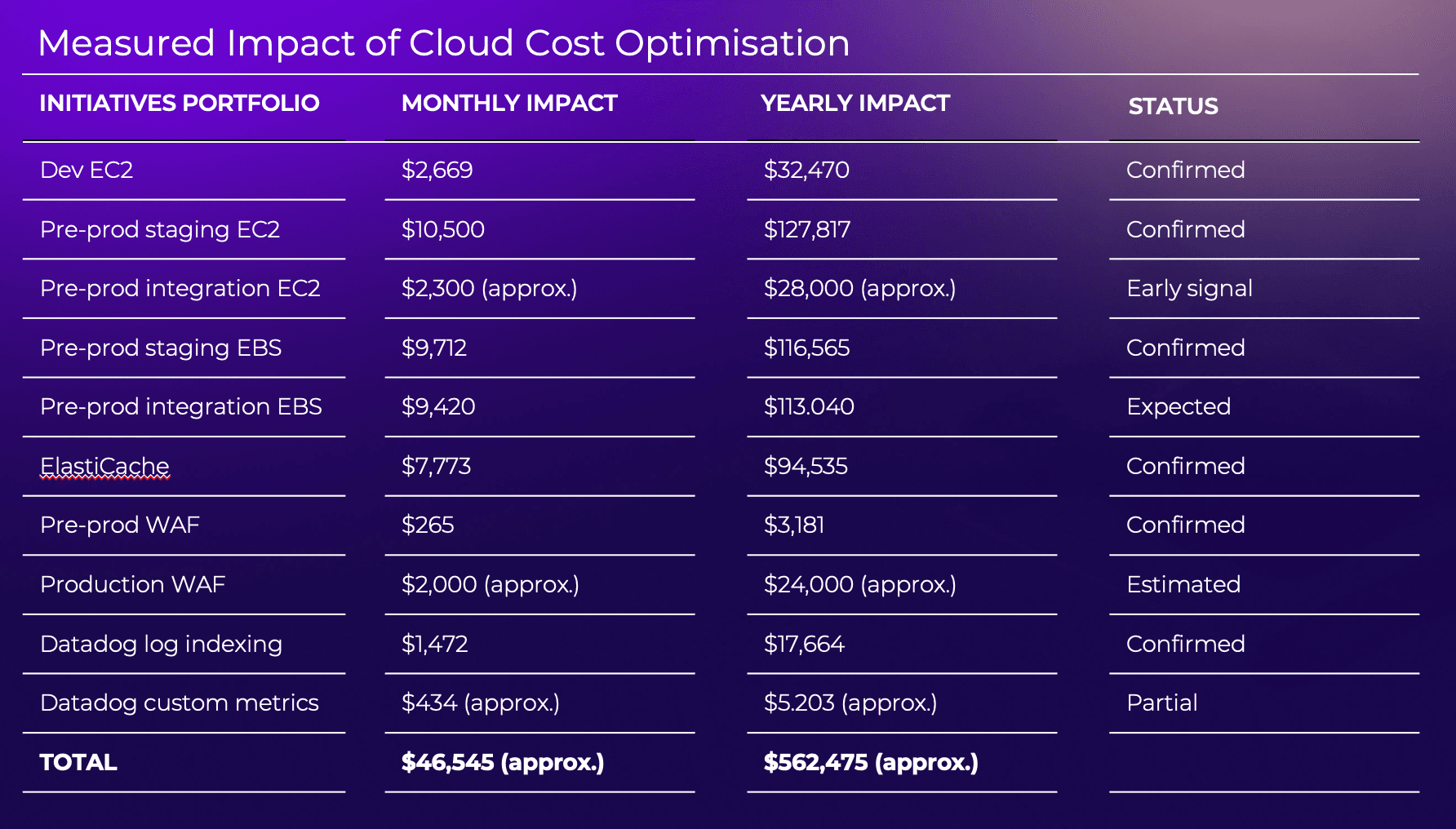
Development environments were cleaned up by deleting long-unused technology stacks. This reduced average EC2 costs from approximately $200/day to $111/day, a 44.4% reduction, equivalent to $2,669/month. In pre-production staging, CPU and memory requests were reduced for selected workloads, enabling node scale-down. This drove an average saving of $10,500/month, with node count reducing by approximately 164 nodes or 39%.
Storage
EBS workloads were migrated from io2 (Provisioned IOPS SSD) to gp3 (General Purpose SSD). For the staging cluster, EBS cost fell from $350.77/day to $27.03/day – a 92.3% reduction, resulting in savings of $9,712/month. The same approach was applied to the integration cluster, with expected steady-state savings of approximately $9,420/month.
Caching
Delivering $7,773/month in confirmed savings
All 28 ElastiCache Redis replication groups in the pre-production account were downsized to cache.t4g.small. Consequently, the average cost fell from $12,232/month to $4,459/month, delivering $7,773/month in confirmed savings – a 63.5% reduction.
Web Application Firewall
Capacity was optimised in both pre-production and production. In the former, costs fell 96.9% from $273.53/month to $8.47/month. In the latter, optimisation of the WebACL reduced its capacity units from 1,658 to below the 1,500 Tier 1 threshold, removing a $0.20-per-million-request surcharge. The resulting saving is estimated at approximately $24K annually.
Observability
Comfirmed savings of $1,472/month were realised.
Datadog was another optimisation area. Converting the WunderGraph Cosmo Router INFO request logs into a pre-indexing metric removed 84.9 million log events per day from indexing, producing confirmed savings of $1,472/month while retaining ERROR/WARN indexing and S3 archival storage.
A separate custom-metrics optimisation reduced ingestion of high-cardinality metrics for part of the frontend fleet. High cardinality occurs when metric labels contain too many unique values (like user IDs, IP addresses, or unique URLs), causing a massive spike in time-series data. Lowering the volume of unique label combinations being stored, helps mitigate monitoring system overload and curb ballooning observability costs. The documented partial impact is approximately $434/month, with the confirmed value still pending the ingested-rate and Metrics Summary split.
Total savings and conclusions
Approximately $46.5K in monthly savings and $562,000 annualised.
Overall cost optimisation initiatives documented to date represent approximately $46.5K in monthly savings and $562K annualised, combining confirmed savings with expected, estimated, partial and early signalled opportunities.
This project demonstrates that cloud migration and cloud cost optimisation can be treated as connected phases of the same technology programme. The migration team’s continued involvement provided a basis for identifying and executing optimisation opportunities directly within the migrated platform, while working alongside the finance department and other teams.
The resulting work was not limited to one AWS service or one optimisation mechanism. It addressed compute sizing, Kubernetes resource allocation, storage architecture, caching capacity, web application firewall configuration and observability consumption across development, pre-production and production.
For our customer, the case demonstrates a concrete outcome: a portfolio currently representing approximately $562K in annualised cost reduction opportunities, supported by service-level measurements and with the maturity of each saving explicitly tracked.
Get in contact to discuss implementing and optimising the cost of your cloud migration.
About Mindera
Mindera is a global consulting and engineering company with 1100+ people, delivering technology solutions across 9 locations — from Brazil to Australia. We work across diverse industries, from Fintech to the Public Sector, offering services in Data, AI, Mobile, and more. We partner with our clients, to understand their customer journeys, their product and deliver high performance, resilient and scalable software systems that create an impact in their users and businesses across the world.