Where AI and AR Virtual Try-On Work Best
If you think fashion is where this product visualisation technology can drive the biggest ROI, prepare to be surprised…

A fundamental perspective shift needs to be made to determine the best uses of AI and AR Virtual Try-On technology.
This blog is an extract from our white paper AI and AR Virtual Try-On: Reducing Returns Through a Strategic Approach to Implementation. Read the full publication here…
In the effort to deliver the best customer experience and save money by reducing returns retailers are turning to artificial intelligence (AI) and augmented reality (AR) technology. Virtual Try-On applications, in particular, have grabbed retailers’ attention.
Why? Because they enable shoppers to visualise items like clothing, makeup, accessories and more on their own bodies virtually via their mobile devices before making a buying decision. They simulate how products look, fit or move. When used effectively, they have the power to increase purchase confidence.
While there’s no doubt that AI and AR Virtual Try-On have the potential to reduce returns and increase conversion rates, the general feeling about the technology across the sector is a mix of optimism and scepticism. That’s because, while it’s been around for some time, few implementations at the enterprise scale have delivered significant return on investment.
Despite the sentiment, investment in the technology continues to grow. Although the four independent studies we reviewed vary in terms of the current value of the market, from USD$15.18 billion (Mordor Intelligence 2025) to USD$3.8 billion (Worldwide Market Reports 2025), they all predict significant compound annual growth rates of between 28.5% (Market.US 2025) and 14.1% (Future Market Insights 2025) over the next 10-15 years.
One of the reasons much of this investment has yet to provide any meaningful return may be because little thought has been given by retailers to the specific business problems the technology might solve.
Blinded by tech
A fundamental perspective shift needs to be made to determine the best uses of AI and AR Virtual Try-On technology. It’s not about identifying whole product categories or industries with the potential to look appealing in a virtual try-on scenario, rather it’s about identifying data-backed problem categories that visualisation may solve, and these problems can apply to any product in any industry regardless of precedent.
One example of this perspective shift in practice is reassessing the notion that the fashion sector is the best or only viable use of virtual try-on. In reality there are fundamental issues with the simulation of clothing and apparel that make AI and AR Virtual Try-On impractical at the least, and at most, a liability retailers would prefer to live without. Less exciting categories like home and garden and kitchen appliances can instead be where virtual try-on really shines.
The key to such differentiations, which we will explore in depth, is finding the intersection of returns data – specifically, percentage rates for certain reasons for return – and the most reliable capabilities of AI and AR Try-On technology.
AR Virtual Try-On: Best for solving spatial and physical fit problems
This version of the technology uses a mobile device’s camera and sensors to measure actual spaces. It then overlays 3D product models at a reasonably accurate scale in the physical environment.
AR Virtual Try-On can be most effective where physical dimensions, placement, or spatial relationships matter. The technology’s ability to visualise size, space and placement makes it key to reducing the 27.7% return rate for furniture (Rocket Returns 2025) due to items not fitting through doors, being the wrong size for a space, or not matching existing furniture.
For example, it can eliminate the common returns problem of customers purchasing sofas that won’t fit through their doorway. AR Virtual Try-On is also ideal for ensuring kitchen and laundry appliances fit designated spaces, which have a 15.8% return rate. This can help to significantly reduce installation failures, returns after delivery, and customer service costs resuting from inaccurate pre-purchase measurements in this category. The same goes for placing products in gardens and outdoor spaces, which currently experience a 14.2% return rate and low conversion rates due to the misjudgement and uncertainty inherent in buying these large big-ticket items.
By accurately visualising flooring, wall colours and fixtures in a customer’s actual room, AR Virtual Try-On can also help avoid shopper hesitation that results in abandoned carts in a category where conversion rates are just 1.5% (Statista Q4 2025). It can also reduce returns following installation due to a product’s appearance not meeting a customer’s expectation.
Retailers currently deploying the technology include Wayfair with its "View in Room 3D" tool (exclusive to the mobile app) that lets customers virtually stage entire rooms with furniture and decor, IKEA with its suite of Kreativ Planning Tools, and Amazon "AR View" which is integrated directly into product pages for quick try-before-you-buy previews.
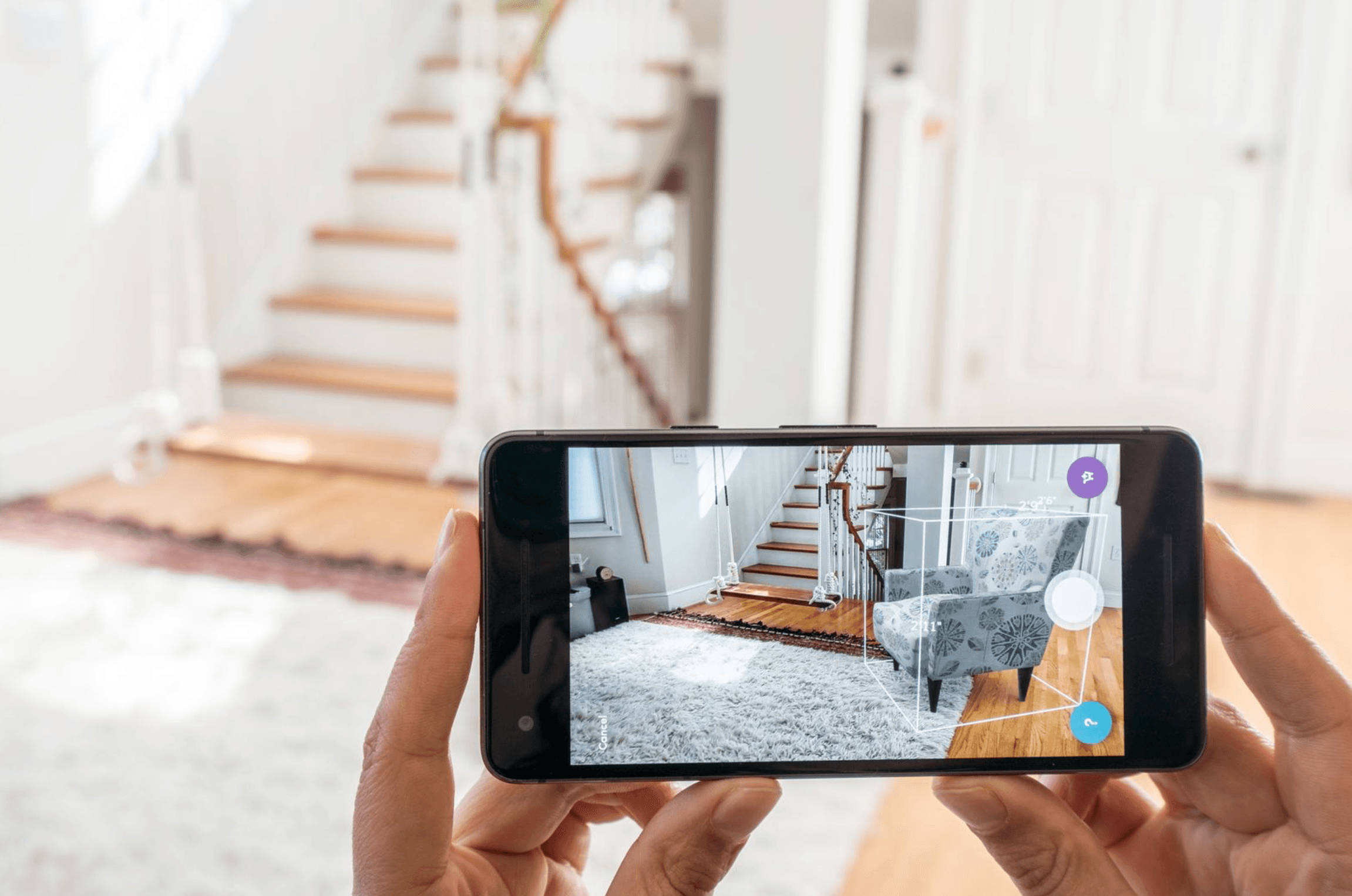
Wayfair View in Room 3D

IKEA Kreativ Planning Tools
AI Virtual Try-On: Best for solving appearance and styling problems
Using generative AI to edit uploaded customer photos, AI Virtual Try-On digitally applies products to the specific images provided. This requires sophisticated image processing and rendering, but not spatial measurement. It’s best suited to products worn on the body, other than clothing, or used on the face to enable customers to gauge their appearance.
AI Virtual Try-On works very well for Eyewear. It can accurately portray how spectacle frames complement a customer's face shape and features. This can play an important role in reducing the high return rates for online eyewear purchases, which hover around 15-20%5, and low conversion due to uncertainty in appearance. It solves similar problems for the online purchasing of accessories like jewellery, watches and fashion products, such as hats, bags and scarves, which have an overall return rate of 16.7%.
The colour-match uncertainty that drives customers to visit physical stores rather than buying cosmetics online can also be alleviated with AI Virtual Try-On. Makeup shades and nail colours, for example, can be accurately painted virtually against a customer’s skin tone. These implementations can prove pivotal in driving cost savings for retailers by reducing the high return rates for makeup and skincare of 15.7% and 11.2% respectively.
Most famous for this approach is Sephora with its “Virtual Artist” app which recorded over 8.5 million try-ons in its first year allowing users to test lipstick, eyeshadow and foundation shades against their skin tone. L’Oreal entered the space through acquiring ModiFace, which already powers Sephora’s virtual tools, and has since been rolling out the technology across its brands such as Maybelline Makeup Tools.

Sephora Virtual Artist
What about fashion?
First thoughts about applications for AR and AI Virtual Try-On usually turn towards fashion retail. This is not surprising as it’s the product category where consumers return the most items, with an overall 24.4% return rate. Within fashion, shoes are the highest overall subcategory with a return rate of 31.4%, while women's fashion is the highest category in ecommerce at 27.8%.
The top two reasons for fashion returns are wrong size and fit (67%) followed by style and colour problems (23%), both of which have the potential to be solved by AI Virtual Try-On. In reality however, key challenges exist. For example, colour matching is quite complex and requires the digital asset (such as photo) to be matched against the true colour of the garment, and then to have the end user device faithfully represent the colour.
Meanwhile, precise size prediction remains more reliable through measurement-based tools. Movement and comfort relating to how fabric behaves and feels during wear is also a personal and subjective experience which cannot be reliably captured by AI. Plus, questions about quality – such as weight of cloth and breathability – still cannot be answered through a completely virtual experience. Success requires understanding where the technology excels versus where traditional approaches remain superior. The main areas where AI Virtual Try-On genuinely solves fashion retailers’ problems include:
- Visual assessment: Modern generative AI can accurately render how prints, patterns, colours and styling elements appear on different body types.
- Styling confidence: Consumers can see complete outfit combinations and style variations without physical try-on.
- Personalisation at scale: Dynamic visualisation of how garments look across diverse body types and skin tones not captured in standard product photography
- Reduced friction: Eliminates the psychological barrier of "I can't imagine how this would look on me".
Currently the most successful implementations combine AI Virtual Try-On for visual confidence with measurement-based fit prediction and return-friendly policies. The technology excels at solving "how will this look on me", while complementary approaches need to handle "how will this fit me."
The big takeaway here is that AI Virtual Try-On in fashion works best when positioned as solving the visual assessment problem, not promising to eliminate all uncertainty. Retailers who understand this distinction and implement accordingly see genuine business value.

Where AI and AR Virtual Try-On Don’t Work
Just as important as applying this technology in the most effective way to the categories where it can have the most impact is recognising where it can’t help retailers at its current level of development and where it can’t generate a return on any kind of investment.
Understanding the scenarios where AI and AR Virtual Try-On work best is vital to optimising value and business impact.
Right now, AI and AR Virtual Try-On can’t help customers make purchase decisions that involve touch, smell, taste, or other non-visual factors. This rules out perfume and food sampling. As mentioned previously, precise clothing fit prediction remains more reliable through measurement-based tools, along with tactile assessments such as how fabric feels with respect to wearability and quality.
There’s also no point implementing the technology where there is no problem to be solved. For example, where customers already convert well online without visualisation tools. The same goes for low-consideration, low-return-rate items.
Understanding the scenarios where AI and AR Virtual Try-On work best is vital to optimising value and business impact. This helps to identify the problems that can be solved, which should always be the starting point, as discussed next.
Read our white paper AI and AR Virtual Try-On: Reducing Returns Through a Strategic Approach to Implementation to find out how to develop a strategic framework to ensure AI and AR Virtual Try-On is applied appropriately from a problem-first perspective to solve measurable business challenges.
About Mindera
Mindera is a global consulting and engineering company with 1100+ people, delivering technology solutions across 9 locations — from Brazil to Australia. We work across diverse industries, from Fintech to the Public Sector, offering services in Data, AI, Mobile, and more. We partner with our clients, to understand their customer journeys, their product and deliver high performance, resilient and scalable software systems that create an impact in their users and businesses across the world.